
Introduction
When business owners decide to get a website, they often use "design" and "development" interchangeably. This creates confusion when hiring agencies, evaluating proposals, or trying to understand why a project costs what it costs. Design and development are distinct disciplines, and understanding the difference helps you make better decisions.
Why This Topic Matters for Your Business
Choosing a designer when you need a developer or vice versa leads to wasted money and disappointing results. A beautifully designed website that is poorly developed will be slow, buggy, and difficult to update. A technically solid website with poor design will fail to convert visitors because it looks unprofessional.
Core Concepts
### What Website Design Covers
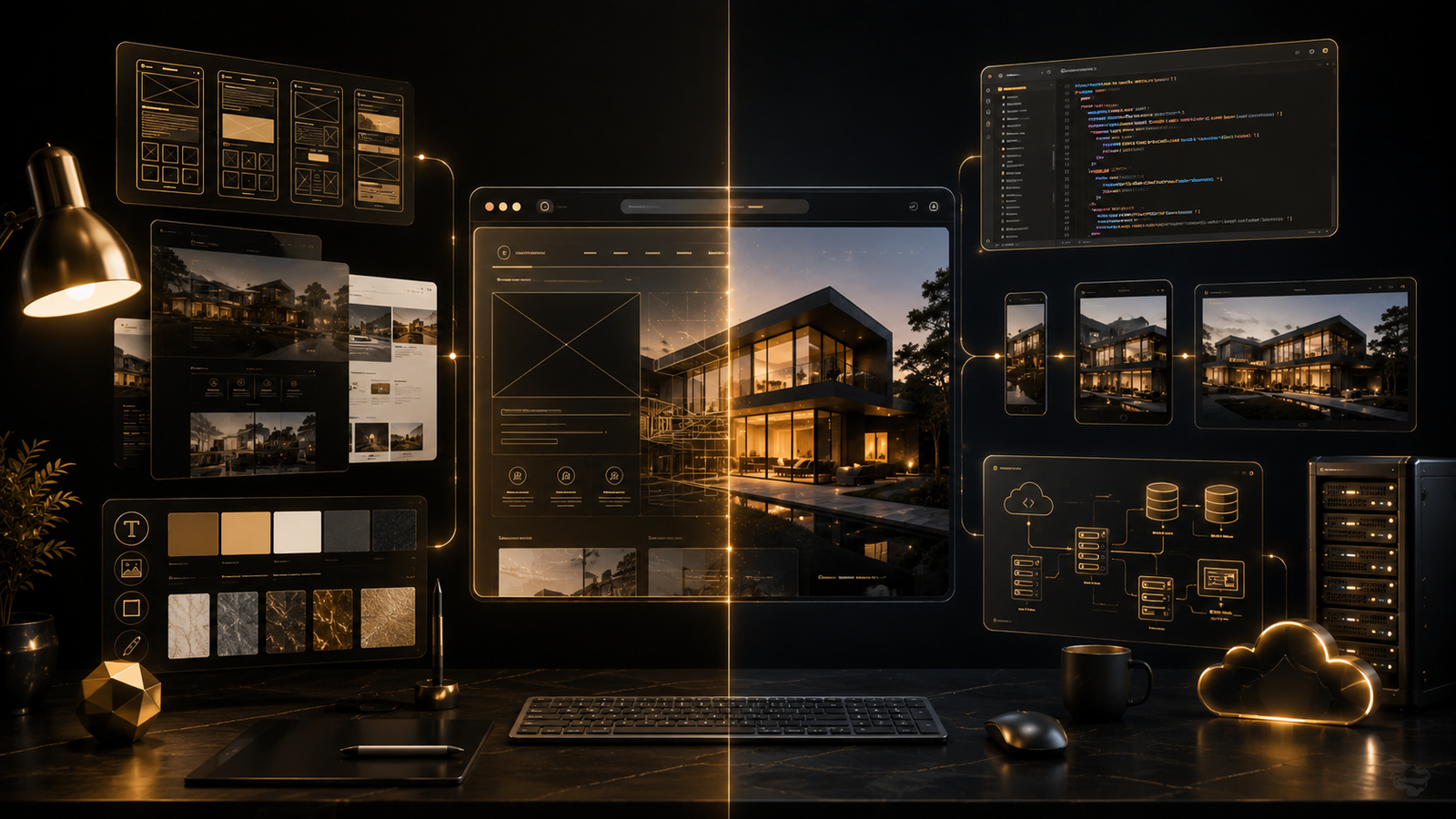
Website design is about how your website looks, feels, and guides visitors toward action. It encompasses visual design, layout, typography, color systems, spacing, and the overall user experience.
A designer thinks about information hierarchy: what should the visitor see first, second, and third. They consider how a page layout guides the eye from the headline to the supporting content to the call-to-action button. They choose typography that communicates your brand personality and color palettes that create the right emotional response.
Website design also covers responsive design decisions. How should the layout adapt from desktop to tablet to phone? Where should the navigation menu collapse? These are design decisions, not development tasks.
The output of the design phase is typically a set of visual mockups and interactive prototypes that show exactly how every page should look across different screen sizes.
### What Website Development Covers
Website development is about building the technical infrastructure that makes your website function. It includes writing code, setting up databases, integrating third-party tools, optimizing performance, and ensuring security.
A developer builds the navigation system, contact forms, search functionality, content management systems, e-commerce capabilities, and every interactive element on your website. They handle hosting setup, domain configuration, SSL certificates, caching, image optimization, and search engine optimization at the technical level.
Front-end development translates design mockups into functional web pages using HTML, CSS, and JavaScript frameworks. Back-end development builds server-side logic, databases, and APIs that power dynamic features.
### The Third Discipline: Strategy
Before design or development begins, there is strategy. What is the website's primary purpose? Who is the target audience? What actions should visitors take? How does the website support broader business goals?
Strategy determines the site architecture, content structure, conversion paths, and technical requirements. Without clear strategy, even beautiful design and flawless development produce a website that fails to generate business results.
Practical Business Examples
A restaurant owner hired a freelance developer to build a website. The developer created a technically functional site with an online menu, photo gallery, and reservation form. But the design was generic, the navigation was confusing on mobile, and the reservation form required seven fields. The website loaded fast but visitors bounced within seconds.
The solution required both disciplines: a designer who could create a premium visual experience while understanding performance constraints, and a developer who could build fast-loading pages that preserved the design intent.
A professional services firm had a different problem. Their existing website was well-designed five years ago but was built on outdated technology. It was slow, not mobile-responsive, and could not integrate with their new CRM system. They needed development expertise to rebuild the technical foundation while preserving the strong visual design.
Common Mistakes
Choosing based on portfolio alone. A designer's portfolio shows their best visual work. It does not tell you whether they understand conversion optimization, mobile experience, or performance.
Treating development as an afterthought. Many businesses invest heavily in design and then rush through development to save budget. This produces a beautiful website that is slow, insecure, or difficult to maintain.
Skipping the strategy phase. Jumping straight to design without defining goals, audience, and requirements leads to multiple rounds of revisions.
Ignoring post-launch requirements. A website is not a one-time project. It requires ongoing updates, security patches, content changes, and performance monitoring.
Best Practices
Invest in strategy before design. Spend time defining your target audience, mapping customer journeys, and establishing clear success metrics.
Hire based on demonstrated results. Look for designers who can explain their reasoning and developers who can demonstrate measurable improvements in site speed and conversion rates.
Prioritize mobile experience. Over 70% of web traffic in India comes from mobile devices. Your mobile experience should be the primary experience.
Choose modern, maintainable technology. Your website should be built on a technology stack that your team can maintain or that your agency supports long-term.
Budget for both disciplines properly. Premium results require balanced investment in strategy, design, and development.
Step-by-Step Framework
Phase 1: Strategy (Week 1 to 2)
- Define your website's primary business goal.
- Identify your target audience and their key needs.
- Map the pages you need and how visitors will navigate between them.
- Establish success metrics: traffic targets, conversion goals, performance benchmarks.
Phase 2: Design (Week 3 to 6)
- Create mood boards and visual direction based on your brand identity.
- Design wireframes for key page templates.
- Develop high-fidelity mockups for desktop and mobile.
- Build an interactive prototype for stakeholder review.
Phase 3: Development (Week 7 to 10)
- Set up hosting, domain, and development environment.
- Build the technical infrastructure and content management system.
- Implement the approved design as functional web pages.
- Integrate third-party tools: analytics, forms, CRM, chat.
- Optimize performance: speed, responsiveness, accessibility.
Phase 4: Launch (Week 11 to 12)
- Test across all browsers and devices.
- Review content accuracy and completeness.
- Set up analytics tracking and conversion monitoring.
- Launch and monitor for any issues.
Actionable Checklist
- Website strategy and goals documented
- Target audience and customer journey mapped
- Site architecture and page structure planned
- Design mockups for desktop and mobile approved
- Content management system selected and configured
- Page speed optimized to under three seconds on mobile
- Conversion tracking installed and tested
- Post-launch maintenance plan in place
Key Takeaways
Website design and website development are distinct disciplines that both contribute to a successful online presence. Design determines how your website looks and guides visitor behavior. Development determines how it functions, performs, and scales. Strategy precedes both and ensures your website serves clear business objectives.
Invest in both disciplines proportionally. The most effective approach treats design and development as equally important investments that require close collaboration.